Tooth Pain After Filling: What Is Normal and When to Get Help
Tooth pain after filling? Learn what tooth sensitivity after filling is normal, how long it may last, and when to seek care from GB Dentistry in Memorial.
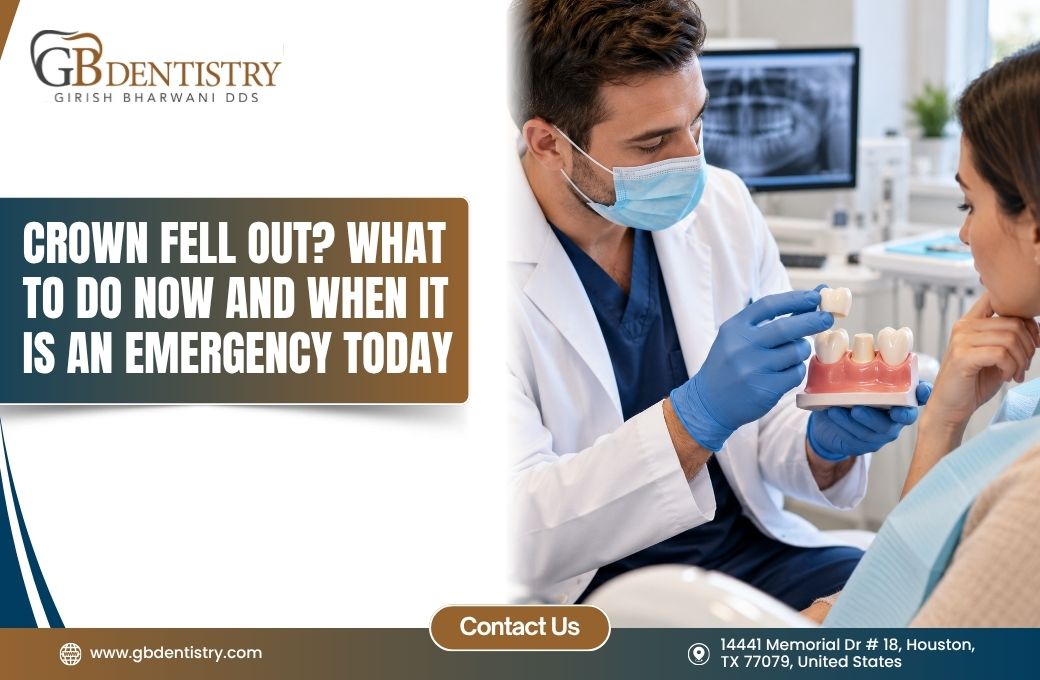
Crown fell out? The safest next step is to protect the exposed tooth, save the crown if possible, and contact the dentists at GB Dentistry promptly for guidance. Even if the tooth does not hurt, the underlying tooth may be vulnerable to sensitivity, decay, or additional damage.
The situation becomes more urgent when there is severe pain, swelling, bleeding, a sharp fractured edge, facial injury, fever, or trouble swallowing or breathing.
This guide explains what to do immediately, when to look for an emergency dentist near me, how temporary and permanent crowns differ, and what to discuss with Dr. Bharwani or the dentists at GB Dentistry in Memorial, Texas.
When a crown comes loose, the first few minutes can affect comfort and help prevent further damage.
Avoid trying to force the crown back into place, especially if the exposed tooth looks shorter, broken, unusually sensitive, or different from the inside of the crown. The fit may have changed, and pressure could irritate the tooth or surrounding tissues.
Rinse your mouth gently with lukewarm water. If you can find the crown, rinse it without scrubbing away any remaining dental cement. Place it in a clean container or small bag and bring it to the appointment.
The dentists at GB Dentistry may be able to assess whether it is intact and potentially usable, although a replacement may be necessary depending on the crown, the tooth, and the reason it came loose.
Once a crown fell out, checking the exposed tooth for damage is more important than forcing a quick fix.
Look at the exposed area in a mirror, but do not probe it with a fingernail, toothpick, or other object.
Make a note of whether the tooth feels sharp, whether part of the tooth appears to be missing, and whether the gum is bleeding. A crown that falls out with a piece of tooth attached requires prompt evaluation.
Until you speak with GB Dentistry, chew on the opposite side and choose softer foods. Keep brushing the area gently, but avoid aggressive pressure directly over the exposed tooth.
Floss carefully by sliding the floss out from the side rather than snapping it upward, which could place unnecessary force on the tooth. When a crown fell out, protecting the tooth from hard foods can reduce irritation before the visit.
If the area is sensitive, avoid very hot, cold, sticky, or sugary foods and drinks. Over-the-counter pain medication may help some adults manage discomfort when used exactly as directed on the product label and when medically appropriate for that person.
Do not place aspirin directly on the gum or tooth, because it can irritate the tissue.
Do not use household glue, super glue, nail glue, or other non-dental adhesives. These products are not designed for oral tissues and can make professional cleaning or treatment more difficult.
In some situations, a crown may sit over the tooth without pressure and without affecting your bite. However, the correct approach depends on why it came out and whether the tooth underneath is intact. Benefits of choosing dental crowns include protecting damaged teeth, restoring chewing function, and improving tooth appearance.
Before attempting any temporary placement, contact the dentists at GB Dentistry for instructions. If your crown fell out, ask for professional advice before using any temporary dental product.
If the crown does not fit easily, feels high, rocks, or causes pain, leave it out. A poor fit can injure the tooth or gum and may create a risk of swallowing or inhaling the crown.
A temporary dental cement sold for this purpose may sometimes be discussed, but it should not replace an examination or be used to force a crown into position.
Tell us about your smile goals, and let’s find the care that fits you.
 Let’s Take Care of Your Smile
Not every loose crown requires an emergency visit, but every lost crown deserves timely attention. The urgency depends on the condition of the underlying tooth, the amount of pain or swelling, the possibility of infection, and whether the crown came out after an injury.
Contact GB Dentistry as soon as possible when you have significant symptoms or the tooth appears damaged.
If the office is closed, follow the practice’s current instructions for urgent care and seek appropriate emergency medical help for serious facial trauma or breathing concerns. If a crown fell out and swelling or severe pain develops, seek prompt dental guidance.
Situations that warrant urgent attention include:
A crown fell out with no tooth left may mean the visible tooth structure has fractured below the dental crown in Memorial.
It could also mean that the crown itself is hollow and the tooth remains inside it. Only an examination, and sometimes dental imaging, can distinguish between these possibilities.
A crown that falls out without pain may still expose the tooth to bacteria, temperature changes, and biting forces. A painless problem can become more complicated if the tooth shifts, breaks further, or develops inflammation. Contact the office promptly rather than waiting several weeks to see whether symptoms appear.
A temporary crown fell out may be especially inconvenient because the underlying tooth has usually been shaped for a final restoration. The exposed tooth can be more vulnerable, and the bite may feel uneven.
Tell the scheduling team whether the crown is temporary or permanent, when it came out, and whether you have pain, swelling, or a broken tooth.
When searching for an emergency dentist near me, provide concise information that helps the office assess urgency. Explain whether the crown is temporary or permanent, whether you still have the crown, and whether the tooth is painful or visibly broken.
Mention any swelling, fever, trauma, or difficulty opening your mouth. Whether the crown fell out suddenly or gradually became loose can help clarify the cause.
Do not assume that the word “emergency” automatically means the crown will be permanently replaced during the first visit. The immediate goal may be to protect the tooth, relieve symptoms, identify infection or fracture, and determine which restoration is appropriate.
Treatment timing depends on the examination and the condition of the tooth. Tell the office when the crown fell out and whether the restoration is temporary or permanent.

At an appointment, Dr. Bharwani or the dentists at GB Dentistry will evaluate both the crown and the tooth beneath it. The appointment is not only about recementing the restoration.
The important question is why it came loose and whether the tooth can still support a crown safely. After a crown fell out, the appointment should address the cause as well as the restoration.
The evaluation may include a visual examination, a bite assessment, and dental imaging when needed. The dentists at GB Dentistry may look for decay, a crack, loss of tooth structure, gum irritation, changes in the bite, or problems with the fit of the restoration. Choosing dental crowns Houston can help restore damaged teeth, protect their structure, and improve overall function.
Tell GB Dentistry if a crown fell out after an injury or while eating sticky food.
The crown itself may be checked for cracks, distortion, wear, and damage to the edges. A crown that appears intact may still no longer fit properly if the underlying tooth has changed.
Conversely, a crown may have failed because of damage within the restoration rather than because the tooth is unsalvageable. When a crown fell out, an examination can reveal whether the fit or supporting tooth has changed.
The appropriate option depends on the findings. Potential paths can include:
These choices involve trade-offs. Recementing may preserve an existing restoration when conditions are favorable, but it is not appropriate if the crown no longer fits or the tooth underneath has deteriorated.
Replacing a crown may require additional time and appointments, but it may be the more predictable approach when the restoration or tooth has been compromised. If your crown fell out, the dentist may discuss recementation, repair, or replacement after examination.
A crown can come loose because of normal wear, cement failure, decay, a bite-related force, an injury, or a fracture in the tooth or restoration.
A crown that repeatedly comes off should not simply be reattached without investigating the reason. Understanding why a crown fell out can help guide the next treatment decision.
For example, if the tooth has lost structure beneath the crown, recementing may provide only a temporary solution.
If the bite places excessive force on the restoration, Dr. Bharwani may need to evaluate how the teeth meet and discuss ways to reduce future stress. The treatment plan should address the cause rather than only the visible event.
Let’s talk about your concerns and create a care plan that fits you.
 Ready to Feel Good About Your Smile?
Crown replacement cost varies because the price is influenced by more than the crown alone. The condition of the tooth, the type of restoration, diagnostic needs, laboratory or fabrication steps, and any treatment required before replacement can all affect the total.
GB Dentistry can provide current financial information after evaluating your specific situation; online estimates should not be treated as a personalized quote. When a crown fell out, the cost discussion should begin with the condition of the tooth.
A replacement may be relatively straightforward when the old crown is damaged but the tooth underneath is sound. Costs and complexity may increase when the appointment also involves treatment for decay, a fracture, infection, gum concerns, or insufficient tooth structure.
Insurance benefits, deductibles, annual limits, and plan exclusions can also vary. Ask the GB Dentistry team which financial and insurance details can be reviewed before treatment.
If you are comparing options, ask whether the quoted amount includes the examination, imaging, temporary restoration, laboratory work, and follow-up care. If the crown fell out because the tooth underneath changed, extra treatment may affect the total fee.
Some practices offer same-day dental crowns in selected circumstances, but same-day treatment is not automatically appropriate for every crown that falls out.
The tooth must be evaluated first, and the restoration must be designed for the amount of tooth structure, bite forces, gum condition, and functional demands involved. Even if a crown fell out recently, same-day replacement may not suit every tooth.
A same-day option may not be suitable when the tooth needs treatment before restoration, when the case requires additional planning, or when a laboratory-made restoration is recommended.
Ask the dentists at GB Dentistry whether same-day dental crowns are available and clinically appropriate for your case rather than choosing an option based only on speed.
Bring the crown in a clean container, along with information about when it was placed if you have it. If another practice made the crown, share any available records or details about recent treatment.
Write down your symptoms, medications, allergies, and the steps you have already taken. If your crown fell out during a meal, avoid chewing on the exposed tooth until you receive advice.
It is also useful to decide what you need to understand before treatment begins: whether the tooth is structurally sound, whether the existing crown can be reused, what temporary protection is needed, and what alternatives exist if replacement is necessary.
Clear questions can make a stressful visit more productive. Bring the restoration and explain when the crown fell out to help the team plan the visit.
No restoration can eliminate every risk of damage or loosening, but everyday habits and regular professional care can help identify problems earlier. Prevention begins with understanding the factors that may place stress on the crown or the tooth supporting it.
Avoid chewing ice, hard candies, pens, fingernails, or other objects that can place concentrated force on a restoration. Sticky foods may pull on a crown, particularly when the cement or tooth structure is already compromised.
If you grind or clench your teeth, discuss that habit with Dr. Bharwani because repeated pressure can affect crowns, bridges, and natural teeth. When a crown fell out, the underlying tooth might need care even if the restoration looks intact.
Continue brushing twice daily with fluoride toothpaste and cleaning between the teeth as directed. Pay attention to the gumline around a crown, where plaque can contribute to gum inflammation and decay at the edge of the restoration.
Good home care does not replace professional examinations, but it supports the tooth and surrounding tissues. If your crown fell out before, avoiding habits that strain restorations may help protect the next one.
Arrange an evaluation if a crown feels loose, your bite suddenly changes, the edge feels sharp, food repeatedly catches around it, or sensitivity persists. These changes do not necessarily mean the crown has failed, but they are reasons to contact GB Dentistry before the restoration comes out completely.
Regular visits allow the dentists at GB Dentistry to monitor the crown, the supporting tooth, the surrounding gums, and the way your bite functions. The recommended interval depends on your oral health and individual needs, so follow the schedule discussed with the practice.
If a crown fell out, preserve the crown, protect the tooth, and contact the office promptly. Seek urgent care for severe pain, swelling, fever, uncontrolled bleeding, major injury, or breathing and swallowing problems. For less urgent situations, avoid delaying simply because the tooth feels normal.
The right next step may be recementation, a temporary restoration, a new crown, treatment of the supporting tooth, or discussion of another restorative option. An evaluation with Dr. Bharwani or the dentists at GB Dentistry can clarify which path fits the condition of your tooth and your treatment goals.
When a crown fell out, it is understandable to focus first on putting it back. The more important question is why it came out and whether the tooth underneath remains strong enough to support a restoration.
Protect the area, save the crown, avoid household adhesives, and contact GB Dentistry for guidance rather than trying to manage the problem indefinitely at home.
I encourage you to seek urgent attention for severe pain, swelling, fever, significant injury, or difficulty breathing or swallowing. If those warning signs are absent, prompt evaluation can still help prevent a manageable crown problem from becoming a larger restorative concern.
We can review the tooth, the crown, available treatment paths, and the expected financial considerations so you can make an informed decision about your care in Memorial, Texas.


Rinse the crown gently, place it in a clean container, protect the exposed tooth, and contact GB Dentistry promptly. Do not use household glue or force the crown back into place.
It may not be a life-threatening emergency, but prompt dental evaluation is still important. An exposed tooth can break, become sensitive, or develop decay even when it does not hurt.
Save the crown and contact the dentists at GB Dentistry promptly. The tooth may be fractured or hidden inside the crown, and an examination with possible imaging is needed to determine the next treatment.
Only follow temporary placement instructions provided by the dentists at GB Dentistry. Never use super glue, and do not force a crown that feels tight, painful, unstable, or different from your normal bite.
Contact GB Dentistry for guidance, avoid sticky or hard foods, and chew on the opposite side. A temporary crown protects a prepared tooth, so leaving it uncovered for an extended period may cause problems.
Bring the intact crown to GB Dentistry for evaluation. It may be possible to reuse it if the fit and supporting tooth are acceptable, but decay, fracture, or changes beneath the crown may require replacement.
Crown replacement cost varies with the restoration, the condition of the tooth, required imaging or treatment, and insurance benefits. GB Dentistry can discuss current financial details after examining your specific situation.
Same-day dental crowns may be suitable in selected cases, but an examination comes first. The dentists at GB Dentistry must consider the tooth’s structure, bite, gum health, and whether other treatment is needed. If your crown fell out, a dental examination can determine whether same-day replacement is an appropriate option.