
How Dental Appliances for Sleep Apnea Can Improve Your Sleep
Dental appliances for sleep apnea may help you sleep more comfortably when snoring, nighttime breathing interruptions, or CPAP challenges are affecting your rest.
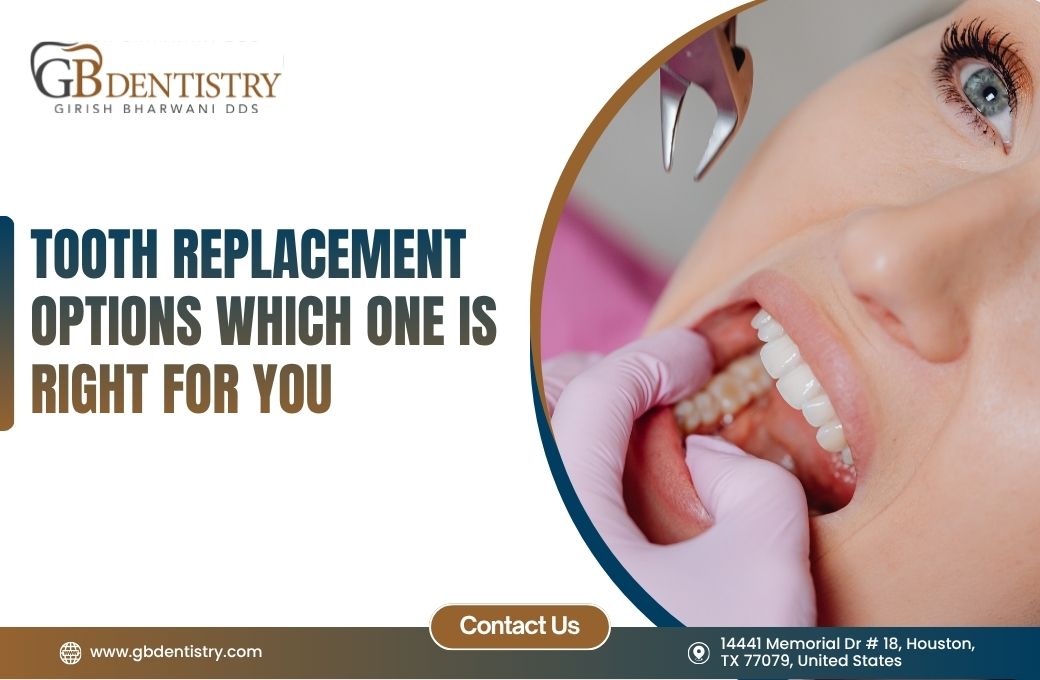
Choosing the right tooth replacement can feel overwhelming when you are already dealing with pain, chewing trouble, or a visible gap in your smile.
If you are comparing options after an extraction or planning ahead for one, the best decision depends on your oral health, timeline, budget, and what you want the final result to do for your bite and daily comfort.
This guide breaks down the most common tooth replacement options in practical terms so you can understand how each one works, what it solves, and where the trade-offs usually are.
We will also look at when wisdom tooth extraction comes first, when urgency matters, and how the dentists at GB Dentistry help patients in Memorial, Texas make a clear, informed plan.
A missing tooth affects more than appearance. It can change how you chew, shift nearby teeth, and make certain areas harder to clean. That is why tooth replacement is not just about filling a space.
It is about protecting function, supporting the surrounding teeth, and choosing a solution that fits your situation.
Before you compare the individual options, it helps to understand the main goals of treatment. The right choice should restore daily function as much as possible, match your comfort level with treatment, and fit the condition of your gums, jawbone, and remaining teeth.
This is where a tooth replacement plan becomes more useful than a quick guess.
When a tooth is lost and not replaced, the nearby teeth can drift into the open space over time. The opposing tooth may also move down or up into the gap, depending on its location.
That can affect your bite and create cleaning challenges that raise the risk of decay and gum problems. Delayed tooth replacement can also make those bite changes harder to correct later.
Bone change is another concern. The jaw naturally remodels when it no longer receives normal stimulation from a tooth root. That does not mean every gap creates an urgent problem, but it does mean long-term planning matters.
The dentists at GB Dentistry usually look at several practical details before recommending a replacement plan:
These factors often matter more than a general rule about what is “best.” Two people with the same missing tooth may need very different approaches.

Tell us about your smile goals, and let’s find the care that fits you.
Most patients are choosing between a dental implant, a bridge, or a removable partial denture. Each option has its own strengths, limitations, and planning needs. The right answer depends on what you want to preserve, what your mouth can support, and how much treatment you are comfortable pursuing.
A thoughtful tooth replacement comparison should make those differences clear before treatment begins.
It is also important to separate temporary replacement from a longer-term solution. Sometimes an immediate cosmetic fix makes sense while the mouth heals. In other cases, the final restoration can be planned after the extraction site stabilizes.
Choose the right dental implants replaces the root of the tooth with a small post placed in the jaw. After healing, it can support a crown that looks and functions like a natural tooth in everyday use.
Implants are often considered when nearby teeth are healthy and when enough bone is available to support treatment. They are not a quick fix in every situation, but they can be a strong option when the goal is to replace one tooth without altering the teeth beside it.
For the right candidate, this tooth replacement option can also make daily cleaning feel more familiar.
A zirconia bridge uses the teeth on either side of the empty space to support a replacement tooth in the middle. This can be a useful option when the adjacent teeth already need crowns or when an implant is not the right fit.
As a tooth replacement choice, a bridge is often judged by how well it balances stability and tooth preservation.
The trade-off is that the neighboring teeth must be shaped to support the bridge. For some patients, that is reasonable. For others, preserving those teeth intact is a major priority.
A removable partial denture can replace one tooth or several teeth and is taken out for cleaning. It may be a practical choice when multiple teeth are missing or when a patient needs a lower-cost interim solution.
This option is usually more dependent on fit and maintenance than a fixed restoration. Some patients appreciate the flexibility, while others prefer the feel and convenience of a fixed solution.
After an extraction, the mouth may need time before a final restoration is placed. During that period, temporary options can help maintain appearance and function while tissues heal and treatment planning continues. This temporary tooth replacement step can make the healing period feel less stressful.
That timing matters especially when the extraction was done for infection, fracture, or a wisdom tooth issue. In those cases, the final replacement plan may depend on how the area heals and whether the site is appropriate for the next step.
The best choice is not always the most permanent or the most familiar. It is the one that makes sense for your health, your timeline, and your priorities. The same replacement can be ideal for one patient and inconvenient for another.
A careful evaluation with Dr. Bharwani or the dentists at GB Dentistry can help you compare the options in a way that is specific to your mouth, not just generic advice. That makes tooth replacement planning more personal and more practical.
If a tooth was lost suddenly, you may be focused on what can be done quickly. If the extraction is planned, you may have more room to prepare for a staged solution. That timing can shape whether you choose a temporary restoration first or move toward a longer-term plan.
Urgency can also matter with wisdom teeth. When people search for wisdom teeth removal near me or emergency wisdom wisdom tooth extraction, they are often dealing with pain, swelling, or a tooth that cannot be cleaned well.
In those situations, the immediate question is not only extraction, but also what happens afterward if other teeth need support or if visible spaces remain.
A replacement that depends on bone support, such as an implant, may not be the same option if the jaw has already changed after tooth loss. Likewise, a bridge depends on healthy neighboring teeth, and a removable option depends on how well it can be stabilized in the mouth.
A tooth replacement that depends on bone or neighboring teeth has to be matched to those limits.
This is why planning should come after an exam and imaging, not before. The mouth sets the limits, and the treatment plan should respect those limits.
Some patients want the least amount of daily upkeep possible. Others want a solution they can clean and remove on their own. Some prefer a fixed restoration because it feels more natural in conversation and chewing. Others want something simpler or more affordable to start.
There is no wrong preference here. The real question is how you want the replacement to fit into your routine over time.
Sometimes the tooth that needs replacement is already damaged beyond repair. Other times, the issue starts with the extraction itself, such as a cracked tooth, deep decay, or a wisdom tooth that is causing crowding or infection.
If the extraction is part of a larger problem, the replacement choice may shift after healing. That is common, and it is one reason patients benefit from discussing both the removal and the replacement plan together instead of treating them as separate decisions.
Keeping the tooth replacement discussion connected to the extraction helps avoid surprises later.
A tooth replacement plan often begins with extraction, especially when the tooth is fractured, severely decayed, infected, or impossible to restore predictably. In that case, the question becomes what the mouth will need after removal, not just how to remove the tooth.
When the extraction is straightforward, replacement planning may be simple. When the case involves infection, swelling, or a difficult wisdom tooth, timing can be more complex.
Wisdom teeth are a common reason patients look for emergency wisdom teeth removal or same day wisdom tooth extraction. These teeth can cause pain, gum inflammation, food trapping, or pressure on neighboring teeth.
Sometimes they need to come out because they are partly erupted or trapped in a way that makes cleaning difficult.
In many of these cases, the extracted wisdom tooth does not require replacement because it is not essential for biting the way a front tooth or first molar is. Still, the situation matters because it affects healing, comfort, and whether other teeth are at risk.
A missing front tooth usually raises more cosmetic concerns, while a missing molar usually raises stronger chewing concerns. That difference can influence whether a temporary restoration is enough for a while or whether a more durable replacement should be planned sooner.
If an extraction is likely to affect your bite or appearance, it is worth asking how the space will be managed during healing and what options make sense once the area is ready.
After removal, the socket and surrounding tissues go through healing changes. The exact timeline varies, and it depends on the tooth, the reason for extraction, and your overall oral health.
Some replacement options can be planned early, but final placement often waits until the site is stable enough for a reliable result.
That is one reason immediate decisions are not always the best decisions. A clear sequence often works better: remove the problem tooth, monitor healing, then finalize the replacement approach. A staged tooth replacement timeline can protect comfort while the area stabilizes.

Many patients start with price, and that is understandable. But cost is not just the first bill. It also includes maintenance, replacement intervals, repair needs, and the practical value of how well the option fits your life.
A lower upfront cost can make sense if you need a short-term bridge to something else. A higher upfront cost can make sense if you want a fixed solution that supports long-term function and fewer day-to-day complications.
This is why tooth replacement value should include daily use, not only the first appointment.
A removable option may be more accessible at the beginning, but it may need adjustments over time. A bridge may involve treatment on neighboring teeth. An implant may require more planning up front, but it does not rely on adjacent teeth for support in the same way.
That does not make one option universally better. It simply means the real comparison should include what happens after placement, not only what happens on the day treatment starts.
Every replacement type has its own cleaning routine. Fixed restorations need careful brushing and flossing around the margins. Removable options need to be cleaned outside the mouth. Dental Implants need attention to gum health so the surrounding tissues stay healthy.
Patients sometimes choose a replacement they like in theory, then struggle with the care routine in practice. It is better to choose something you can realistically maintain every day.
Before choosing, it helps to ask:
These questions can keep the decision focused on your actual life, not just a list of procedures.
A thoughtful replacement plan starts with an exam, a conversation about your goals, and, when needed, imaging to evaluate the extraction site and surrounding structures. That step is especially important if you are dealing with an urgent tooth removal or trying to decide whether a space should be restored soon.
At GB Dentistry, the goal is to help patients in Memorial and nearby areas understand what is happening in the mouth and what each option would mean in real life. Local tooth replacement planning can also make follow-up easier if the plan changes.
The dentists at GB Dentistry may look at the tooth or extraction site, nearby teeth, gum health, bite relationships, and whether the area can support the restoration you are considering. For wisdom tooth cases, the focus often includes comfort, cleanup challenges, and the risk of repeated flare-ups.
If the problem started with pain or swelling, the first step may be resolving the immediate issue before replacement planning becomes realistic.

Let’s talk about your concerns and create a care plan that fits you.
Bring a list of the symptoms you have noticed, how long the issue has been present, and what matters most to you. For example, some patients care most about appearance. Others care more about chewing on that side again. Others want the simplest maintenance routine possible.
The more clearly you explain your goals, the easier it is to narrow the choices and avoid a plan that looks good on paper but does not fit your daily life.
Timing should be part of the discussion from the start. Ask whether the replacement can be planned now, whether healing needs to happen first, and whether a temporary option makes sense while the final decision is being made.
That is especially useful if you are looking into missing tooth replacement after an extraction or if you are trying to understand whether an urgent wisdom tooth problem changes your longer-term plan.
The best tooth replacement is the one that fits your mouth, your goals, and the condition of the surrounding teeth and gums.
In our experience at GB Dentistry, the clearest decisions come after a careful exam, a realistic discussion of timing, and an honest look at what will be easiest for you to maintain.
If you are dealing with a missing tooth, planning an extraction, or trying to understand whether a recent wisdom tooth problem affects your next step, we encourage you to discuss the options early.
A good plan should protect your bite, respect your healing, and give you confidence about what comes next. Thoughtful tooth replacement planning should feel clear, practical, and tailored to your health.


The best option depends on the tooth, your bone and gum health, and your goals. Dental implants, bridges, and removable partials each solve different problems, so the right choice is the one that fits your mouth and timeline. For Memorial patients, a tooth replacement discussion at GB Dentistry can help narrow those choices.
Usually no. Wisdom teeth are not typically replaced after extraction because they do not play the same role as front teeth or major chewing teeth. The focus is usually on healing and protecting nearby teeth.
It depends on the cause of the loss and the condition of the site. Some cases can be planned soon after healing starts, while others need more time first. Dr. Bharwani can help you decide on the right timing.
Neither is always better. An implant preserves the neighboring teeth, while a bridge may be useful when nearby teeth already need crowns or an implant is not a good fit. The decision depends on your exam findings.
If pain, swelling, or infection is making the tooth hard to clean or function with, emergency evaluation is important. The dentists at GB Dentistry can assess the Dental extraction and discuss whether removal is the right next step.
Same day wisdom tooth extraction may be possible in some situations, but it depends on the exam, imaging, and the complexity of the tooth. Availability and treatment planning should be confirmed with the practice.
That depends on your routine. Fixed options stay in place but need careful cleaning around them, while removable options are easier to take out for cleaning but require daily handling and maintenance.
Yes. The dentists at GB Dentistry can evaluate the extraction site, nearby teeth, and your goals so you can compare your options with clear guidance instead of guessing.