How Dental Appliances for Sleep Apnea Can Improve Your Sleep
Dental appliances for sleep apnea may help you sleep more comfortably when snoring, nighttime breathing interruptions, or CPAP challenges are affecting your rest.
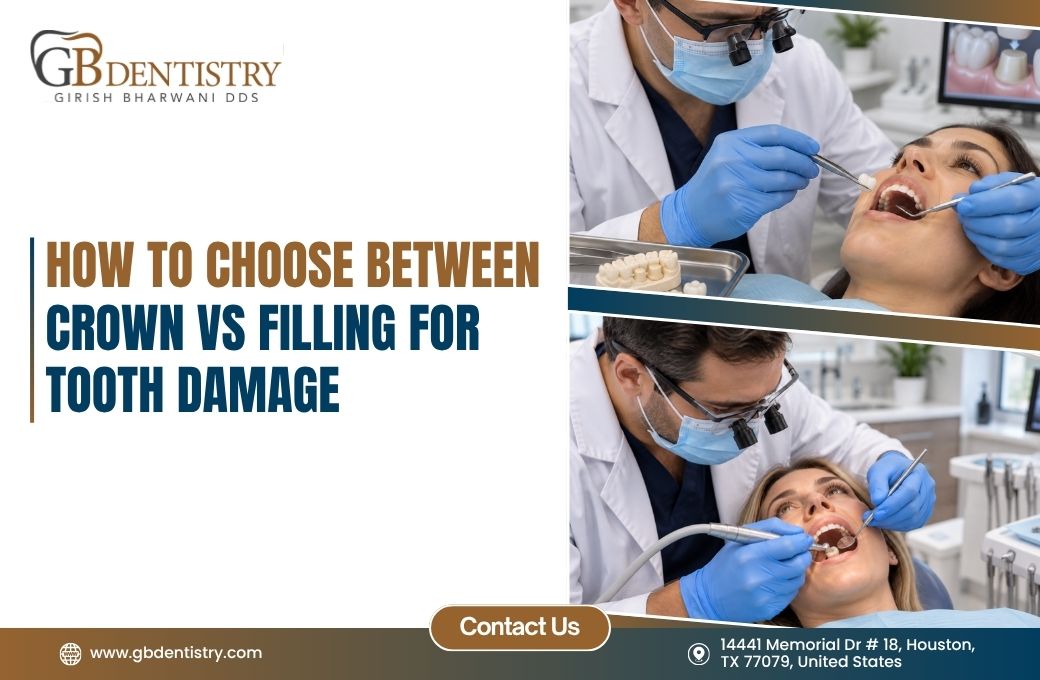
Crown vs filling decisions can be difficult when a damaged tooth is not causing much discomfort, yet the right restoration may affect how well the tooth functions for years to come.
Understanding the difference helps you have a more productive conversation with Dr. Bharwani or the dentists at GB Dentistry. This detail matters in a crown vs filling decision.
This guide explains what each treatment does, how dentists evaluate tooth damage, when a dental crown may be more appropriate than a filling, and what happens when a tooth is too compromised to restore with either option.
You will also learn what to ask before choosing a treatment plan in Memorial, Texas.
The basic distinction is straightforward: a filling replaces a limited amount of missing tooth structure, while a crown covers and protects most or all of the visible portion of a damaged tooth.
The decision, however, depends on more than the size of a cavity. The remaining tooth structure, location of the damage, bite forces, symptoms, and risk of future fracture all matter. A careful crown vs filling discussion should account for this factor.
A filling repairs a tooth decay in memorial, a small fracture, or another localized defect has been removed. The restoration fills the prepared area and allows the tooth to regain a usable shape.
Fillings may be made from tooth-colored composite or other restorative materials selected according to the tooth and clinical circumstances.
Fillings are generally most suitable when the surrounding enamel and dentin remain strong. For example, a small cavity on the chewing surface may require only a filling if the tooth walls are intact and the restoration can be supported by healthy structure.
In that situation, removing additional tooth structure to place a crown may not be necessary. This is one reason crown vs filling decisions depend on the full clinical picture.
A filling is not simply a smaller version of a crown. It depends on the tooth being able to support the restoration from within its existing walls.
If those walls are thin, cracked, undermined by decay, or missing, the filling may not provide enough protection against normal chewing pressure. In a crown vs filling evaluation, details like this can influence the recommendation.
What is a dental crown? A dental crown is a custom-made restoration that fits over the remaining visible portion of a prepared tooth. It is used to restore the tooth’s shape, strength, and function when a filling would leave too much vulnerable structure exposed.
A crown may be considered for a tooth with extensive decay, a large older filling, significant wear, a substantial fracture, or a weakened structure after root canal treatment. The goal is not merely to cover damage.
Dr. Bharwani evaluates whether the tooth has enough healthy foundation to support a crown and whether the restoration can be designed to work with the surrounding teeth. Understanding this point makes a crown vs filling conversation more useful.
Crowns require more preparation than fillings because the tooth must be shaped to receive the restoration. That makes the decision important: a crown can provide broader coverage when needed, but it is not automatically the better choice for every cavity or chipped tooth.
A back tooth absorbs considerable force during chewing. A weakened cusp or a large missing section may be at greater risk of breaking than a small defect in a lower-stress area.
The location of the damage, the way the teeth meet, and habits such as clenching or grinding can influence the recommendation. Questions about crown vs filling often depend on factors like this.
A front tooth may also need a crown, although appearance, remaining enamel, and the type of fracture require careful consideration. A tooth-colored filling can sometimes repair a limited front-tooth defect, while a crown may be discussed when the damage is extensive or the tooth needs more complete coverage.

Tell us about your smile goals, and let’s find the care that fits you.
The most useful way to compare treatments is to focus on the condition of the tooth, not on the restoration that sounds simpler. Composite Teeth Filling Treatment can be a conservative option for repairing teeth affected by cavities or minor damage, as composite resin is bonded to the tooth to restore its shape and function. However, placing a filling in a tooth that cannot adequately support it may leave the tooth vulnerable to further damage. A dental professional can assess the extent of the damage and recommend whether a composite filling or a more protective restoration is appropriate.
A crown may offer broader protection, but using one when a smaller restoration is adequate can involve more preparation than necessary. This factor is worth discussing when considering crown vs filling treatment.
A tooth can have enough decay or missing structure that there is no longer a reliable foundation for a filling.
The same issue can develop after several replacement fillings enlarge the original preparation. Even when the tooth is not painful, thin walls around a large restoration may flex under chewing pressure.
During an evaluation, the dentists at GB Dentistry look at how much healthy tooth remains after compromised structure is removed.
If the remaining walls are unable to support a filling predictably, a crown may be discussed as a way to surround and reinforce the tooth. At GB Dentistry, crown vs filling options are considered alongside the examination findings.
A filling can repair a localized cavity, but it does not necessarily stabilize a tooth that is split or cracked through a load-bearing area.
A crack may also behave differently depending on whether it is limited to enamel, extends into dentin, reaches the pulp, or continues below the gumline. That context can matter when reviewing crown vs filling options.
Common warning signs can include pain when biting, sensitivity when releasing a bite, or discomfort that comes and goes. These symptoms do not identify the cause by themselves. Dr. Bharwani may need to examine the tooth, review dental images when appropriate, and assess the bite before recommending a restoration.
A crown may help protect the remaining tooth when the damage is restorable and the supporting tissues are suitable. It cannot make every crack treatable, and it does not eliminate the need to evaluate the tooth’s long-term prognosis. This point can help clarify a crown vs filling recommendation.
A tooth that has received root canal treatment may have lost substantial internal structure from decay, fracture, or access through the top of the tooth. Depending on the amount of remaining tooth, a crown may be recommended to reduce the risk of further structural damage.
The timing and type of restoration depend on the tooth’s condition and the treatment plan.
A root canal does not automatically mean that every tooth requires the same restoration, so the final recommendation should be based on an examination rather than a general rule. This detail matters in a crown vs filling decision.
A filling deserves closer evaluation when the tooth has a large area of missing structure, repeated repairs, visible cracks, a broken cusp, or symptoms during chewing. Waiting may also allow a small defect to become more difficult to restore, although the rate of change varies widely between teeth.
Seek prompt dental guidance for swelling, severe or persistent pain, a major fracture, fever, or an injury. Emergency dentistry in memorial concerns may require attention before a final crown-versus-filling decision is made. A careful crown vs filling discussion should account for this factor.

Choosing between a crown and filling is a clinical decision built from several observations. The dentists at GB Dentistry consider the tooth itself, the surrounding tissues, and the way the restoration must function in your bite.
A conversation about treatment should include both the immediate repair and the factors that could affect future maintenance.
The evaluation may include a visual examination, gentle testing, a bite assessment, and dental images when needed.
The purpose is to determine the extent of decay or fracture, inspect the supporting bone and gum area, and identify issues that may not be visible from the surface. This is one reason crown vs. filling decisions depend on the full clinical picture. Is a Teeth Crown Right for You? A dental crown may be recommended when a tooth has extensive decay, a significant fracture, or weakened structure that requires additional protection. Your dentist can evaluate the tooth’s condition, explain the available treatment options, and help determine whether a crown or a filling is the most appropriate solution.
The dentists also consider whether the tooth can be isolated and restored properly. Moisture control, access, the position of the tooth, and the condition of the surrounding teeth can all affect how a restoration is planned. In a crown vs filling evaluation, details like this can influence the recommendation.
No single symptom or image tells the entire story. For example, sensitivity may result from decay, a cracked tooth, an exposed root, a worn restoration, or another issue.
A tooth that feels comfortable may still have significant structural weakness, while a painful tooth may need evaluation for pulpal or supporting-tissue problems before a filling or crown is placed.
A practical consultation should clarify several points:
These questions help separate the restoration from the diagnosis. A crown is not a substitute for treating an infection, and a filling is not a solution for every fracture.
If the pulp is involved, additional treatment may be needed before the tooth can be restored. Understanding this point makes a crown vs filling conversation more useful.
The decision often involves a trade-off. A filling may preserve more original tooth structure and involve a smaller restoration.
A crown may provide coverage for a tooth that has lost too much support for a filling, but it requires preparation around the tooth and ongoing care of the crown and its margins.
The best choice is the option that matches the tooth’s actual condition. At GB Dentistry, the discussion should include why a restoration is recommended, what alternatives may exist, and what could happen if treatment is postponed.
That information allows you to make a decision based on protection and prognosis rather than appearance or the shortest appointment. Questions about crown vs filling often depend on factors like this.
Some damaged teeth cannot be restored successfully with a filling or crown alone. The key question becomes whether enough healthy tooth remains above and below the gumline to support a restoration and whether the surrounding tissues are healthy enough to maintain it.
If decay or a fracture reaches the pulp, the tooth may require treatment directed at the inner nerve tissue before a final restoration is considered. If the damage extends too far below the gumline or the tooth is split, a crown may not be a predictable solution.
Dr. Bharwani can explain whether the tooth is restorable and what factors influence that assessment. This factor is worth discussing when considering crown vs filling treatment.
A tooth with infection, significant bone loss, or inadequate remaining structure may need a different sequence of care. The treatment plan should address the source of the problem rather than simply cover the visible damage. At GB Dentistry, crown vs filling options are considered alongside the examination findings.
When a tooth cannot be restored, the dentists at GB Dentistry can discuss appropriate replacement considerations based on the location of the missing tooth, the neighboring teeth, bone support, general oral health, and your preferences. Options may include a dental bridge or another tooth-replacement approach when clinically appropriate.
A dental bridge uses adjacent teeth or other planned support to help replace a missing tooth. A traditional bridge and a cantilever dental bridge do not use the same design.
A cantilever bridge is supported from one side rather than from both sides, so whether it is appropriate depends heavily on location, bite forces, and the condition of the supporting tooth or teeth.
It should not be selected solely because it appears less extensive. That context can matter when reviewing crown vs filling options.
Replacement planning is separate from deciding between a filling and crown for a restorable tooth, but understanding the alternatives can prevent rushed decisions after a tooth fractures. If extraction becomes necessary, ask how the space may affect chewing, neighboring teeth, appearance, and future treatment options.
Tooth damage does not always progress at a predictable rate. A cavity can enlarge, a filling can fail, or a crack can extend without producing constant pain.
Delaying care may reduce the number of restoration choices available, although only an examination can determine the current situation. This point can help clarify a crown vs filling recommendation.
If a crown has already been placed and later becomes damaged, loose, or poorly fitting, a dental crown replacement may or may not be possible.
The existing crown, remaining tooth, supporting tissues, and cause of the problem must be evaluated first. Replacing the crown without addressing decay, bite stress, or a structural issue may not solve the underlying concern.

Let’s talk about your concerns and create a care plan that fits you.
A treatment consultation is more useful when you arrive ready to describe what you have noticed and ask how each option fits the condition of the tooth. You do not need to diagnose the problem in advance.
Clear details about symptoms and history can help Dr. Bharwani or the dentists at GB Dentistry focus the evaluation. This detail matters in a crown vs filling decision.
Note whether discomfort occurs with cold, heat, sweets, chewing, or releasing a bite. Also mention whether a filling has broken, whether the tooth has been injured, and whether you clench or grind. Pain that lingers after hot or cold exposure, swelling, or spontaneous discomfort deserves specific attention.
Bring information about previous treatment on the tooth, including an older crown, filling, root canal, or dental trauma.
A restoration that has lasted for years may fail for a different reason than one that repeatedly breaks, and that history can influence the next recommendation. A careful crown vs filling discussion should account for this factor.
Ask about the amount of tooth structure that must be removed, the expected function of the restoration, and what follow-up may be required.
It is also reasonable to ask what signs would indicate that the tooth needs additional treatment and whether a temporary restoration is expected during the process. This is one reason crown vs filling decisions depend on the full clinical picture.
Consider these decision points:
Treatment timing and costs can vary based on the diagnosis, materials, laboratory work, insurance plan, and whether additional care is needed. The GB Dentistry team can explain the treatment plan and financial details that apply to your situation rather than relying on a generic estimate.
Both fillings and crowns require regular brushing, cleaning between teeth, and routine professional care. A crown is not immune to decay at its edge, gum inflammation, wear, or damage from excessive force.
A filling can also wear, chip, or develop leakage over time. In a crown vs filling evaluation, details like this can influence the recommendation.
Avoid using teeth to open packages or bite hard nonfood objects. If you grind or clench, ask whether that behavior may be contributing to repeated damage and whether a protective approach should be considered. Contact GB Dentistry if a restoration feels loose, changes your bite, causes persistent sensitivity, or breaks.
When you are comparing a crown vs filling, the most important question is not which treatment sounds easier. It is whether the remaining tooth can safely support the restoration and continue functioning under your normal bite.
A filling may be appropriate for a contained defect, while a crown may be better suited to a tooth with extensive damage, a large prior restoration, or weakened walls. Understanding this point makes a crown vs filling conversation more useful.
I encourage you to ask why a treatment is recommended, what alternatives are realistic, and whether the tooth needs additional care before it is restored.
At GB Dentistry, we can evaluate the condition of the tooth and discuss a plan that reflects its structure, function, and surrounding oral health. If you have pain, swelling, a broken restoration, or a new crack, schedule an evaluation rather than waiting for symptoms to become more severe.


A filling repairs a localized area of damage, while a dental crown covers most of the visible tooth. Dr. Bharwani chooses between them based on remaining tooth structure, cracks, decay, and bite forces. Questions about crown vs filling often depend on factors like this.
A filling may suit a small defect with strong surrounding walls. A crown may be considered when decay, fractures, wear, or a large filling has weakened much of the tooth. An examination is needed to decide.
A dental crown covers and restores a weakened or extensively damaged tooth. It may be discussed for large cavities, broken cusps, substantial fillings, severe wear, or selected teeth after root canal treatment. This factor is worth discussing when considering crown vs filling treatment.
Sometimes, but it depends on the crack’s location, depth, and effect on the tooth’s support. A filling may not stabilize a load-bearing fracture, so the dentists at GB Dentistry must evaluate the tooth first. At GB Dentistry, crown vs filling options are considered alongside the examination findings.
Not necessarily. The need for a crown depends on the tooth’s location, remaining structure, fracture risk, and type of damage. Dr. Bharwani can explain whether broader coverage is appropriate for the specific tooth.
A cantilever dental bridge is supported from one side rather than both sides. Its suitability depends on the missing tooth’s location, bite forces, and supporting teeth, so it is not appropriate for every replacement situation. That context can matter when reviewing crown vs filling options.
A dental crown replacement may be possible, but the existing crown, remaining tooth, gums, bite, and cause of failure must be assessed. Treating underlying decay or structural problems may be necessary first.
Patients in Memorial and nearby areas can discuss damaged-tooth options with Dr. Bharwani or the dentists at GB Dentistry. Bring symptom details and restoration history so the evaluation can address both function and long-term planning. This point can help clarify a crown vs filling recommendation.