
Composite Bonding vs Veneers: Which Is Right for You?
Compare composite bonding vs veneers for chips, gaps, and discoloration, including prep, durability, maintenance, cost, and options at GB Dentistry in Memorial.
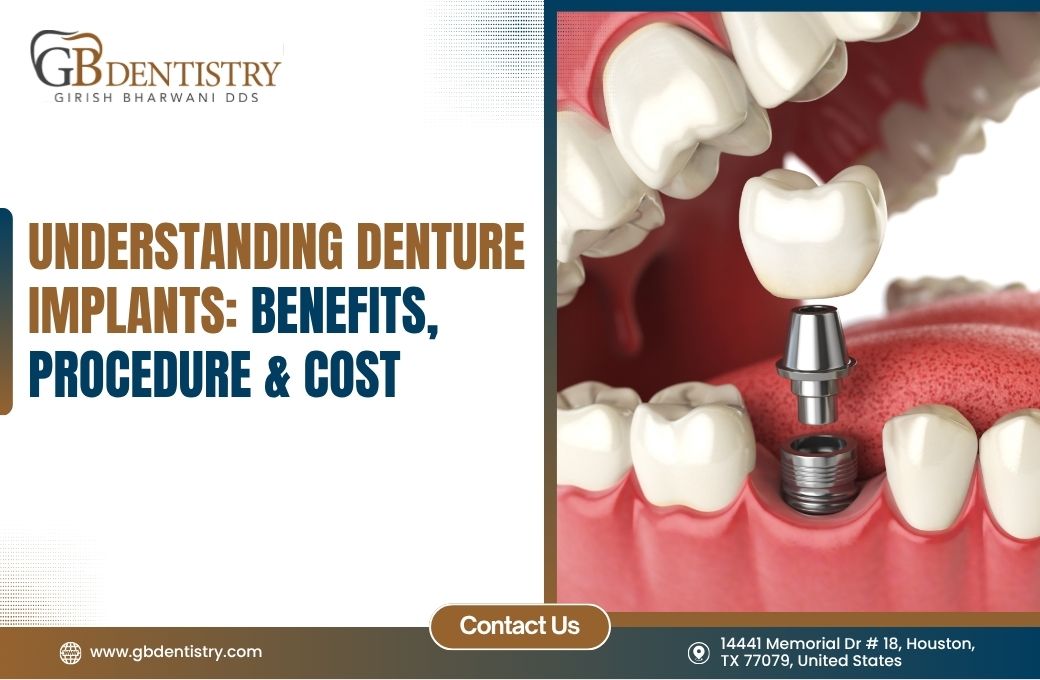
Denture implants can be a better long-term fit for people who are tired of loose, shifting dentures and want a more stable way to eat, speak, and smile with confidence.
If you have been comparing dental implants and dentures, it is natural to want clear answers before you commit to treatment.
This guide explains how implant supported dentures work, what the procedure usually involves, what affects cost, and how to think through the trade-offs before you move forward with Dr. Bharwani or the dentists at GB Dentistry in Memorial, Texas.
A denture implants discussion should always begin with what you want to improve day to day.
Denture in memorial combine the removable or fixed replacement of a denture with the support of dental implants anchored in the jaw. That support changes the experience for many people, especially if traditional dentures have started to feel unstable, sore, or inconvenient.
The main value is not just comfort. Denture implants can also improve chewing support, help reduce movement during speaking, and give many patients a more predictable daily routine. The exact design varies, so it helps to understand the basic options before you compare treatment plans.
Traditional dentures rest on the gums and rely on suction, fit, and adhesives for stability. That setup can work for some people, but it often becomes less dependable as the ridge of the jaw changes over time.
Implant supported dentures attach to implants placed in the jaw. That added anchoring can reduce slipping and help the denture feel more secure.
For some patients, the difference is noticeable right away; for others, it becomes more obvious during meals, conversations, or longer days when a traditional denture would normally start to shift. That is one reason denture implants are often discussed when looseness keeps returning.
There is no single design that works for everyone. Some patients do well with a removable overdenture that snaps onto implants, while others may be candidates for a fixed full-arch restoration that only a dental professional removes.
The right option depends on bone support, oral health, budget, cleaning preferences, and the amount of stability you need. When people search for permanent dentures near me, they are often really asking for a solution that feels secure enough to stop thinking about it all day.
In many cases, implant supported dentures are the closest match to that goal, but the treatment plan still has to fit the mouth and the person. Denture implants can be helpful, but the design still needs to match your cleaning routine.
Denture implants are often considered for adults who need full dentures due to missing all or most of their teeth, or who are missing multiple teeth and want better stability than a conventional denture provides. Healthy gums, enough jawbone to support implants, and a commitment to good oral hygiene all play an important role in determining candidacy.
Some patients may need extra planning first, such as treatment for gum disease, extraction planning, or bone evaluation. That is why candidacy should be discussed carefully rather than assumed. A thoughtful exam and imaging help Dr.
Bharwani and the dentists at GB Dentistry determine whether implant support is realistic and which design makes the most sense. A denture implants evaluation should make those limits clear from the start.
Tell us about your smile goals, and let’s find the care that fits you.
The procedure is usually planned in stages. That approach gives the dental team time to evaluate your oral health, place the implants carefully, and make sure the final restoration fits your bite and daily needs.
Understanding the process ahead of time often reduces anxiety. It also helps you see where time, healing, and follow-up visits fit into the bigger picture.
The first step is a detailed exam. The dentists at GB Dentistry may evaluate your gums, remaining teeth, bite, bone levels, and overall oral health. Imaging is often used to help determine whether the jaw can support implants and where they should be placed.
This planning phase matters because the quality of the final result depends heavily on placement, spacing, and how the denture will distribute chewing forces. If bone loss or other issues are present, the treatment plan may need to be adjusted before implant placement can begin.
Once the plan is finalized, the implants are placed into the jaw. The number of implants depends on the design being considered and the goals of treatment. After placement, the implants need time to integrate with the bone.
That healing period is important because it is what allows the implants to become stable enough to support the denture.
The length of healing can vary from person to person and from one treatment plan to another, so it is best to expect a customized timeline rather than a fixed one. For denture implants, predictable healing is part of the overall result.
After healing, the denture is connected to the implants. In some cases, the existing denture can be modified; in others, a new prosthesis is made to match the implant positions and bite.
Adjustments are common. Even when the treatment is well planned, small changes may be needed to improve comfort, balance, or speech.
This is one reason people considering porcelain teeth for dentures or other premium materials should ask how the final prosthesis will be built, how it will feel, and what maintenance it may need over time.
After the procedure, follow-up visits help confirm that the implants are healing properly and that the denture is functioning as intended. Good home care matters too. Daily cleaning, careful handling if the denture is removable, and routine dental visits all help protect the long-term investment.
If you are comparing denture repair treatment in Memorial with a more complete replacement plan, it helps to think about the bigger picture. Repairs can solve a short-term issue, but they do not always address fit problems caused by bone changes or long-standing instability.
Implant support may be the more practical answer when the real issue is ongoing movement, not just a cracked tooth or worn base. This is where denture implants may solve a deeper stability problem.
Most people researching denture implants are trying to solve a daily problem: a denture that slips, clicks, feels bulky, or makes eating stressful. The benefits can be significant, but the treatment also comes with responsibilities and limitations that should be understood up front.
A balanced view helps you make a decision that fits your health, budget, and expectations instead of choosing a treatment based only on marketing language.
The most common benefit is improved stability. When the denture is anchored by implants, many patients notice less movement during speaking and eating. That can make meals feel less frustrating and social situations less distracting.
Other possible advantages include better biting support, improved confidence, and less reliance on adhesives. Some patients also appreciate that implant support may help preserve jawbone better than a traditional denture alone, although the amount of preservation can vary.
Denture implants still require surgery, healing, and ongoing maintenance. They are not a same-day shortcut for every patient, and they are not automatically the right answer for every mouth.
Cost is another practical factor. Implant supported dentures usually involve more planning and a greater upfront investment than conventional dentures. Some patients also need preliminary care before treatment can begin. For example, gum treatment, extractions, or bone-related steps may add time and complexity.
Denture implants should be compared with the full treatment path, not only the first cost.
Not every denture problem calls for implants. If the issue is a worn tooth, a broken base, or a denture that simply needs adjustment, a repair or remake may be more appropriate.
That is why the evaluation matters so much. A careful exam can separate a simple fix from a larger stability problem. The dentists at GB Dentistry can help you compare those options without pushing you toward a more complex treatment if it is not necessary.

Cost is one of the biggest reasons people hesitate to explore full mouth dental implants or denture implants. That hesitation is understandable because the final cost depends on several clinical and practical factors rather than one flat fee.
The most useful way to think about cost is to break it into what drives the price, what may be included in the treatment plan, and how the long-term value compares with repeated denture adjustments or replacements.
Several details can influence the cost of implant supported dentures, including the number of implants, the materials used, whether extractions are needed, whether bone or gum treatment is required, and whether the final restoration is removable or fixed.
Other factors can include imaging, temporary prosthetics, laboratory work, follow-up visits, and the complexity of the bite. If you are comparing options, ask for a treatment plan that explains what is included and what may be separate so you can evaluate the total picture, not just the headline number.
A denture implants estimate should make these moving parts clear.
A lower quote may not include all the steps needed for a stable result. In implant dentistry, the quality of planning and the fit of the final prosthesis matter as much as the starting price.
That does not mean the most expensive option is automatically the right one either. It means the better comparison is value, predictability, and suitability for your mouth.
If you are weighing dental implants and dentures against a traditional denture, it helps to compare function over time, not just the first appointment cost.
Before starting treatment, ask what type of denture is being recommended, how many appointments are likely, whether temporary teeth are expected, and what maintenance looks like after placement.
You should also ask whether the plan involves repairs, remake, or staged treatment first. Clear answers make it easier to plan financially and practically. At GB Dentistry, this kind of conversation is especially useful for patients who want a more stable solution but still need to understand the steps involved.
Instead of asking only, “How much does it cost?” it is often smarter to ask, “What problem am I trying to solve, and how long do I want the solution to last before I need to revisit it?”
That framing helps you compare conventional dentures, implant supported dentures, and possible repair work in a more honest way. It also keeps the decision focused on your actual daily needs rather than a one-size-fits-all answer.
Choosing denture implants is not just about wanting a better smile. It is about matching the treatment to your health, your habits, and the way you want your mouth to function every day.
A practical decision usually starts with a few clear questions about stability, bone support, maintenance, and whether you are prepared for a surgical treatment path.
If your denture moves when you eat, causes sore spots often, or makes you avoid certain foods, it may be worth discussing implant support. The same is true if you feel limited in conversations because you are constantly aware of the denture shifting.
Patients who have tried repeated relines, adhesives, or repairs without lasting improvement often benefit from a more thorough evaluation. That is especially true when the underlying issue is jawbone change rather than the denture itself.
Oral health is only part of the picture. Smoking, uncontrolled medical conditions, poor home care, and untreated gum disease can all affect treatment planning and healing. None of these automatically rule out treatment, but they do change the discussion.
The dentists at GB Dentistry will usually want to understand your full health history before recommending a plan. That helps avoid unrealistic expectations and supports safer decision-making.
When you are deciding between a traditional denture and an implant-supported plan, it helps to ask yourself what bothers you most: movement, chewing, appearance, maintenance, or long-term predictability.
A good question to bring into the consultation is whether the main problem is the fit of the denture itself or the support underneath it. That distinction often determines whether a repair is enough or whether implant support is worth considering.
A careful evaluation should explain your options in plain language and make room for your priorities. If a provider is recommending a fixed or removable implant solution, you should understand why that design is being suggested and what maintenance it will require.
That kind of clarity matters for anyone searching for permanent dentures near me, because the right answer is not just about location. It is about whether the treatment is suited to your mouth, your goals, and your expectations for everyday use.
Denture implants are most helpful when they solve the right problem for the right patient.
Let’s talk about your concerns and create a care plan that fits you.
Denture treatment often works best when the practice understands the day-to-day needs of local patients, including access to follow-up care, repair concerns, and long-term maintenance. That can make a big difference after the initial treatment is finished.
If you are looking for denture implants in Memorial, it helps to choose a team that can evaluate whether you need new dentures, a repair, or a more stable implant-supported option based on your actual condition.
If your denture suddenly stops fitting, causes a new sore spot, cracks, or begins to feel loose more often than before, do not assume the problem will fix itself. These issues can grow into bigger problems if the underlying cause is ignored.
A prompt evaluation can help determine whether the denture needs adjustment, repair, or replacement. In some cases, what looks like a denture problem is really a change in the mouth that needs a different kind of treatment.
At GB Dentistry, the dentists can help you sort through the choices without jumping straight to a complex solution. That may include evaluating whether the current denture can be repaired, whether a new prosthesis is needed, or whether implant support would offer a better fit for your goals.
For patients who want a steadier option than traditional dentures, that conversation can be the turning point. It gives you a practical way to compare treatment choices and decide what makes sense before committing to surgery or a remake.
Denture implants can be a strong option for the right patient, but the best decision always starts with a careful evaluation of your mouth, your health, and your daily needs.
In my experience, patients feel more confident when they understand not just the benefits, but also the maintenance, cost factors, and trade-offs involved.
If you are considering implant supported dentures, I encourage you to bring your questions to GB Dentistry in Memorial. We can help you compare your options clearly so you can decide whether a repair, a traditional denture, or a more stable implant-supported plan is the better fit for you.
A denture implants conversation at GB Dentistry can help you weigh those choices with less confusion.


Denture implants are dentures supported by dental implants placed in the jaw. They are designed to improve stability, reduce slipping, and make daily eating and speaking more predictable.
They can be, especially if your current denture feels loose or unstable. The best choice depends on your bone support, oral health, budget, and how much stability you want day to day.
The timeline varies because treatment is often staged. It usually includes consultation, implant placement, healing, and then attachment of the final denture, so your plan should be customized.
Cost depends on the number of implants, the type of denture, extractions, and whether bone or gum treatment is needed. GB Dentistry can review the plan so you understand what affects the total.
Good candidates usually have missing teeth, healthy enough gums, and enough jawbone to support implants. Some patients need extra treatment first, so an exam is the best place to start.
Possibly, depending on your oral health and treatment goals. Some implant-supported options are fixed, while others are removable, so Dr. Bharwani can help compare the choices.
Yes. They need daily cleaning and regular dental visits to protect the gums, implants, and denture fit. Care instructions differ depending on whether the denture is removable or fixed.
Sometimes, yes. If the issue is a crack, worn tooth, or small fit problem, denture repair treatment in Memorial may be appropriate. If the problem is ongoing looseness, implants may be worth discussing.