Sleep Bruxism and Teeth Grinding: Causes and Treatment
Learn how sleep bruxism can cause jaw pain and tooth damage, plus evaluation and treatment options from GB Dentistry for patients in Memorial, Texas today.
Tooth caps can protect damaged or weak teeth when fillings no longer provide enough support, but choosing a crown involves more than covering the visible portion of a tooth.
You may be comparing ceramic, gold, silver-colored, or other metal options while wondering whether a crown is truly necessary.
This guide explains how crowns work, when they may help, how materials differ, what the process involves, and which questions to discuss with Dr. Bharwani or the dentists at GB Dentistry in Memorial, Texas.
The goal is to help you make a thoughtful decision rather than choose based on appearance or a material name alone.
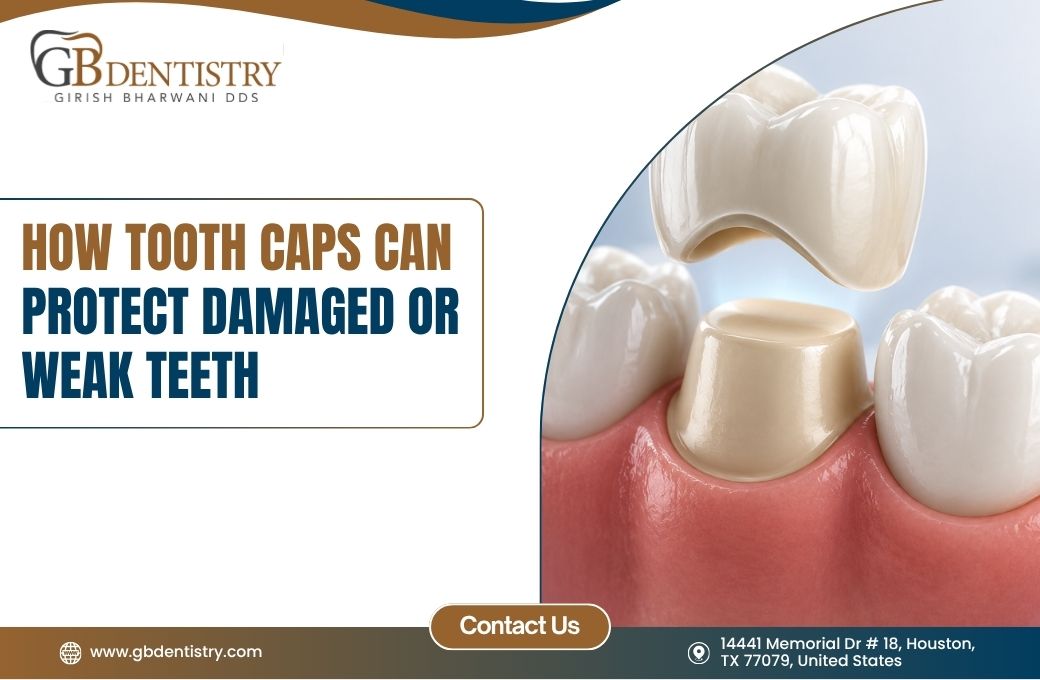
A dental crowns in Memorial is a custom restoration that covers the portion of a tooth above the gumline.
People often call crowns “tooth caps” because the restoration fits over the prepared tooth like a protective covering. The crown is shaped to restore function, tooth contours, and, when appropriate, appearance.
A crown does not make every tooth indestructible, and it cannot repair an untreated infection or replace a missing root. Its purpose is to help hold together and protect a tooth that has lost too much natural structure to function reliably with a filling alone.
Fillings work well when enough healthy tooth structure remains to support the restoration. However, a large cavity, an old filling, a crack, or repeated dental work can leave the remaining walls thin. In these situations, Dental Caps for Teeth may provide added protection and strength, helping restore the tooth and reduce the risk of further damage.
Biting forces may then cause the tooth to flex or fracture around the filling.
A crown may be considered when the remaining tooth needs coverage and reinforcement around the biting surfaces. This is especially relevant for back teeth, which absorb substantial pressure during chewing.
The appropriate choice depends on the amount and location of remaining tooth structure, the condition of the root, your bite, and whether tooth decay or infection is present. For tooth caps, long-term success also depends on the health of the supporting tooth and gums.
Crowns are commonly considered for teeth that are:
A tooth that hurts when you bite, reacts to temperature, or has a visible crack deserves an evaluation rather than an automatic crown. Those symptoms can have several causes, and covering the tooth without identifying the cause may not address the underlying problem.
Tell us about your smile goals, and let’s find the care that fits you.
A well-planned crown can restore a more usable biting surface and shield vulnerable tooth structure from some of the forces that contribute to further damage.
It can also help restore the shape of a tooth so it contacts neighboring teeth appropriately. When tooth caps are appropriate, the design should protect the tooth without creating unnecessary bulk.
A crown cannot reverse gum disease, eliminate bacteria inside an infected tooth, or compensate for a poor fit. It also cannot prevent every future problem.
Daily cleaning, regular examinations, managing clenching or grinding, and returning promptly if the crown feels loose or painful all remain important.
The decision to place tooth caps should follow an examination, not just a visual assessment. At GB Dentistry, the dentists consider the tooth’s structure, symptoms, surrounding gums, bite, and long-term restorability before discussing options.
A crown may be appropriate, but sometimes a more conservative restoration, root canal treatment, extraction, or no immediate treatment makes more sense.
The first step is understanding why the tooth is weak. Dr. Bharwani may assess the visible tooth and the way it contacts neighboring teeth.
Imaging may also be recommended when the roots, bone, or areas below the gumline need evaluation. The specific examination and imaging approach varies with your symptoms and dental history.
Important questions include whether decay extends below the gumline, whether the tooth is cracked, whether the nerve is inflamed or infected, and whether enough sound structure remains for a predictable restoration.
When tooth caps are being considered, the recommendation should reflect the condition and function of that specific tooth.
A crown placed on a tooth with an untreated infection may not solve the problem. In some situations, treatment inside the tooth must be addressed first.
Root canal treatment and a crown serve different purposes. Root canal treatment addresses diseased or infected tissue inside the tooth. A crown covers and protects the remaining tooth structure when coverage is needed afterward. One does not automatically replace the other.
Not every root canal-treated tooth has the same restorative needs. The location of the tooth, how much structure remains, the bite, and the type of restoration already present all matter.
Dr. Bharwani can explain whether a crown is recommended and what risks may exist if coverage is delayed. The best tooth caps balance protection, fit, appearance, and the condition of the remaining tooth.
A dental bridge replaces a missing tooth with an artificial tooth connected to crowns or other restorations on neighboring support teeth. In this setting, the dental crowns are not simply protecting weak teeth; they also help support the bridge.
Bridge planning requires careful attention to the support teeth, gum health, bite, spacing, and cleaning access beneath the replacement tooth.
If you are considering tooth replacement, ask the dentists at GB Dentistry how a bridge compares with other available options for your circumstances.
The best choice depends on your oral health and treatment goals rather than on one feature alone. For tooth caps, the treatment plan should also account for bite forces, remaining structure, and long-term maintenance.
A cracked or weakened tooth may continue to deteriorate even when symptoms are mild. A small fracture can become harder to restore if it extends farther through the tooth or below the gumline.
That does not mean every concern requires an emergency crown, but it does mean persistent symptoms should not be ignored.
Seek prompt dental attention for swelling, fever, severe or worsening pain, a facial injury, uncontrolled bleeding, or difficulty breathing or swallowing.
If a temporary restoration falls out, keep it safe, avoid chewing on that side, and contact GB Dentistry for guidance rather than using household glue.

The material affects appearance, strength, tooth preparation, wear on opposing teeth, and sometimes suitability for a particular location in the mouth.
There is no single material that is right for every tooth or every person. The discussion should balance clinical needs with your preferences and budget considerations, which can vary by restoration and coverage.
Ceramic dental crowns are often considered when a natural-looking appearance is a priority. Modern dental ceramics can be designed to resemble the color and translucency of neighboring teeth, making them a common topic for visible teeth.
Their suitability depends on the specific ceramic, the tooth’s location, the available space, and your bite.
Ceramic is not one uniform material. Different ceramics have different handling and strength characteristics, so the dentists at GB Dentistry may recommend an option based on the tooth being restored rather than appearance alone.
Clenching, grinding, limited clearance, or heavy biting forces may affect the discussion.
Gold dental crowns are made from dental alloys rather than pure gold. They are known for their metallic appearance and may be considered for certain back teeth because metal restorations can be designed with relatively thin walls while maintaining useful strength.
Their color is a significant consideration for people who prefer a tooth-colored restoration.
Gold-colored restorations may be practical in areas where appearance is less important, but they are not automatically appropriate for every patient. The condition of the tooth, the bite, neighboring restorations, and material compatibility all deserve review with Dr. Bharwani.
“Silver dental crowns” may refer informally to crowns with a silver-colored metal appearance. Metal dental crowns can be made from different alloys, and their properties are not identical.
The exact material should be identified before treatment so you understand its appearance and why it is being recommended.
Metal restorations may offer durability and can be useful where there is limited space, but their metallic color makes them less appealing to many people for front teeth.
Some individuals may also have concerns about metal sensitivity or allergies. Tell the dentists at GB Dentistry about any known reactions to metals or prior dental materials. When tooth caps are being considered, the recommendation should reflect the condition and function of that specific tooth.
Instead of asking only which crown material is “best,” consider these questions:
A material that looks ideal in a photograph may not be the most suitable choice for a heavily loaded back tooth.
Likewise, a strong metal option may not meet your appearance goals for a front tooth. The treatment plan should account for both function and the result you are comfortable living with.
Let’s talk about your concerns and create a care plan that fits you.
 Ready to Feel Good About Your Smile?
Knowing the usual stages can make the decision less uncertain. The exact sequence varies according to the tooth, the condition of the surrounding tissues, the type of restoration, and whether other treatment is needed first. GB Dentistry can explain the expected plan after an examination.
When a crown is planned, the tooth is shaped so the restoration can fit over it while preserving as much healthy structure as possible.
The amount of preparation depends on the tooth and the selected material. If decay or an old restoration is removed, the remaining structure is evaluated again before the crown is finalized.
An impression or digital scan may be used to communicate the tooth’s shape and bite relationship to the dental laboratory or restorative workflow. Shade selection is particularly important for ceramic restorations.
Neighboring teeth, lighting, and your natural tooth color can influence the final appearance. For tooth caps, the treatment plan should also account for bite forces, remaining structure, and long-term maintenance.
A temporary crown may protect the prepared tooth while the final restoration is being made. Temporary restorations are not the same as the final crown and may feel different at first.
Follow the instructions provided by the dentists at GB Dentistry, especially regarding sticky foods, cleaning around the area, and what to do if the temporary crown loosens.
Some sensitivity after preparation can occur, but significant, persistent, or worsening pain should be reported.
A temporary crown that feels high when you bite can affect comfort and should be checked rather than tolerated. Well-planned tooth caps should fit the bite and be maintainable with daily home care.
At the final visit, the restoration is evaluated for fit, contacts with neighboring teeth, color when relevant, and bite. You should be able to describe any concern before the crown is secured.
A restoration that feels slightly unfamiliar may settle as you adjust, but pressure, sharp edges, looseness, or a bite that feels uneven warrants communication with the office.
The final crown is designed to function with the rest of your mouth, not in isolation.
Small adjustments may be appropriate, but repeated problems can indicate an issue that needs further evaluation. For tooth caps, a careful fit helps the restoration work comfortably with neighboring and opposing teeth.
A crowned tooth still has natural tooth structure at the gumline and underneath the restoration. Decay can develop around the edges if plaque remains there, and the gums around the crown can become irritated.
Brush twice daily with fluoride toothpaste unless the dentists at GB Dentistry recommend a different routine, clean between the teeth, and attend recommended examinations.
If you clench or grind, ask whether a protective appliance should be discussed. Avoid using your teeth to open packages or bite hard nonfood objects, since those habits can damage natural teeth and restorations alike.
Contact GB Dentistry if the crown chips, cracks, moves, or changes how your bite feels.
Searching for “tooth caps near me” usually means you want prompt, convenient care, but proximity should not be the only deciding factor.
You also need an office that can evaluate why the tooth is damaged, explain alternatives, discuss materials clearly, and plan follow-up when needed. Patients in Memorial and nearby Texas communities can begin that conversation with GB Dentistry.
A focused consultation is easier when you know what you want to clarify. Consider asking:
You can also ask how the proposed restoration will interact with your bite and nearby teeth. If appearance matters, discuss the shade and the visibility of any metal.
If cost or insurance is part of your decision, ask the office to review the financial details available for your specific plan rather than relying on general online estimates. For tooth caps, daily cleaning and routine evaluations help protect the supporting tooth and gums.
A broken tooth, severe pain, swelling, or an injury may require prompt assessment. Emergency dentistry in memorial timing depends on the symptoms and the condition of the tooth.
Until you receive guidance, avoid chewing on the affected side and do not place aspirin directly on the gum or tooth.
A lost crown is also worth reporting. Keep the restoration in a clean container and bring it to the appointment if requested.
Do not assume it can safely be reattached without examining the tooth underneath; decay, fracture, or changes in fit may be present. Tooth caps can also be considered when a weakened tooth needs broader coverage.
The most useful crown is one that fits your clinical situation and a routine you can maintain. Think beyond the day of placement: Can you clean around it consistently?
Are you likely to grind at night? Will the material meet your appearance expectations? Is the tooth part of a larger bridge or restorative plan?
At GB Dentistry, the dentists can use your examination findings and priorities to discuss those trade-offs. A careful conversation before treatment can help prevent surprises and make it easier to recognize when follow-up is needed.
A tooth cap is not simply a cover placed over a damaged tooth. It is part of a plan to preserve useful tooth structure, restore function, and address the reason the tooth became weak.
With tooth caps, follow-up matters because the supporting tooth and surrounding gum still require ongoing care.
The right choice can differ between a front tooth and a molar, between a tooth that is cracked and one that has extensive decay, and between someone who rarely grinds and someone who does so regularly.
I encourage you to seek an evaluation when a tooth is painful, fractured, unusually sensitive, or supporting an old filling that continues to fail.
During a visit at GB Dentistry, we can discuss whether a crown is appropriate, compare ceramic and metal options, and explain what care the tooth may need before and after restoration.
If you are looking for tooth caps near me in the Memorial area, the next practical step is to schedule a consultation so your decision is based on the condition of your tooth—not on appearance or online descriptions alone.


Dental crowns, often called caps, cover and protect teeth weakened by decay, cracks, large fillings, wear, or root canal treatment when a filling may not provide enough support.
Neither is automatically better. Ceramic may suit visible teeth and appearance goals, while metal may suit certain high-force or limited-space areas. Dr. Bharwani can compare options for your tooth.
Gold dental crowns are typically made from dental alloys containing gold and other metals, not pure gold. Their strength, appearance, and suitability depend on the tooth, bite, and restoration plan.
Silver dental crowns usually means silver-colored metal crowns. Availability and material choice vary, so ask the dentists at GB Dentistry which options are appropriate for your tooth and appearance preferences.
A filling may be suitable when enough healthy tooth remains. A crown may be discussed when decay, cracks, or an old restoration has weakened the tooth substantially. An examination is needed to decide.
The process may involve preparation, a temporary restoration, and placement of the final crown. The sequence varies with the tooth and any needed treatment, so GB Dentistry can explain your expected visits.
A crown may protect a restorable cracked tooth, but pain can also indicate decay, nerve inflammation, or infection. Dr. Bharwani should evaluate the cause before deciding whether a crown is appropriate.
Look for an office that evaluates the cause of damage, explains crown materials and alternatives, and provides follow-up guidance. GB Dentistry serves patients in Memorial and nearby communities.